
Festival del Manito de Ocú (11 al 14 de Agosto).
El
Festival Nacional del Manito Ocueño es un
festival folklórico de Panamá. Se realiza la segunda semana cada
mes de agosto, según Ley Nacional. Se le llamó Festival Nacional del
Manito, pues Manito es una palabra que representa la hermandad
entre hermanos, característica de los ocueños que acostumbran a saludarse de
mano y decir Ta' la Manito
El
festival fue ideado por un grupo de educadores ocueños, que vieron la necesidad
de formalizar aquellos festivales y ferias que se realizaban en Ocú por sus
ancestros desde los tiempos en que Panamá aún se encontraba unida a Colombia. Fue en el mes de agosto del año 1967 (cuando se le
pone un nombre a aquellas festividades realizadas desde inicios de la República
de Panamá) que se celebra de una manera más formal este festival.
Pero
no fue hasta diciembre de 1999, cuando se alcanza la aprobación de la Ley 53,
que declara al Festival Nacional del manito en Ocú, como Fiesta Folklórica
Nacional de la República de Panamá. Ocú,
el pueblo sede del Festival Nacional del Manito, está ubicado en la Provincia de Herrera,
República de Panamá.
Algunos Bailes Ocueños
·
Mejorana por 25,
·
Cumbia Zapateada,
·
Socabón Llanero,
·
La Gallina,
·
El Zapatero,
·
El Poncho
·
La Marucha (Popular baile, que sirve de antesala
al Tradicional Duelo del Tamarindo, una tradición en la que dos
hombres se enfrentan a muerte por Honor o por el Amor de una Mujer)

Clare of Assisi, Nun. 11 August 1253
 Clare
Offreduccio, born in 1194, was the daughter of a wealthy family in Assisi
(43:04 N 12:37 E). When she was eighteen years old, she heard a sermon by
Francis of Assisi, and was moved by it to follow the example of the Franciscan
brothers and vow herself to a life of poverty. Her family was horrified, and
brought her back home by force; but one night, in a gesture both tactical and
symbolic, she slipped out of her house through "the door of the dead"
(a small side door that was traditionally opened only to carry out a corpse)
and returned to the house of the Franciscans. Francis cut off her hair, and
placed her in a nearby convent. Later a house was found for her, and she was
eventually joined by two of her sisters, her widowed mother, and several members
of the wealthy Ubaldini family of Florence. Clare's best friend, Pacifica,
could not resist, and joined them, too.
Clare
Offreduccio, born in 1194, was the daughter of a wealthy family in Assisi
(43:04 N 12:37 E). When she was eighteen years old, she heard a sermon by
Francis of Assisi, and was moved by it to follow the example of the Franciscan
brothers and vow herself to a life of poverty. Her family was horrified, and
brought her back home by force; but one night, in a gesture both tactical and
symbolic, she slipped out of her house through "the door of the dead"
(a small side door that was traditionally opened only to carry out a corpse)
and returned to the house of the Franciscans. Francis cut off her hair, and
placed her in a nearby convent. Later a house was found for her, and she was
eventually joined by two of her sisters, her widowed mother, and several members
of the wealthy Ubaldini family of Florence. Clare's best friend, Pacifica,
could not resist, and joined them, too.
The sisters of
her order came to be known informally as Minoresses (Franciscan brothers are
Friars Minor = "lesser brothers") or as Poor Clares. When the order
was formed, Francis suggested Clare for the Superior. But she refused the
position until she turned twenty-one. They devoted themselves to prayer,
nursing the sick, and works of mercy for the poor and neglected.
They adopted a
rule of life of extreme austerity (more so than of any other order of women up
to that time) and of absolute poverty, both individually and collectively. They
had no beds. They slept on twigs with patched hemp for blankets. Wind and rain
seeped through cracks in the ceilings. They ate very little, with no meat at
all. Whatever they ate was food they begged for. Clare made sure she fasted
more than anyone else. Despite this way of life, or perhaps because of it, the
followers of Clare were the most beautiful young girls from the best families
of Assisi.
The community
of Poor Clares continues to this day, both in the Roman and in the Anglican
communions.
Laurence, Deacon and Martyr. 10 August 258

Laurence (or
Lawrence) was chief of the seven deacons of the congregation at Rome, the seven
men who, like Stephen and his companions (Acts 6:1-6), were in charge of
administering the church budget, particularly with regard to the care of the
poor. In 257, the emperor Valerian began a persecution aimed chiefly at the
clergy and the laity of the upper classes. All Church property was confiscated
and meetings of Christians were forbidden. The bishop of Rome, Sixtus II, and
most of his clergy were executed on 7 August 258, and Laurence on the 10th.
This much from the near-contemporary records of the Church.
The accounts
recorded about a century later by Ambrose (see 7 Dec) and the poet Prudentius
say that, as Sixtus was being led to his death, Laurence followed him, saying,
"Will you go to heaven and leave me behind?" and that the bishop
replied, "Be comforted, you will follow me in three days." They go on
to say that the Roman prefect, knowing that Laurence was the principal
financial officer, promised to set him free if he would surrender the wealth of
the Church. Laurence agreed, but said that it would take him three days to
gather it. During those three days, he placed all the money at his disposal in
the hands of trustworthy stewards, and then assembled the sick, the aged, and
the poor, the widows and orphans of the congregation, presented them to the
prefect, and said, "These are the treasures of the Church." The
enraged prefect ordered him to be roasted alive on a gridiron. Laurence bore
the torture with great calmness, saying to his executioners at one time,
"You may turn me over; I am done on this side." The spectacle of his
courage made a great impression on the people of Rome, and made many converts,
while greatly reducing among pagans the belief that Christianity was a socially
undesirable movement that should be stamped out.
The details of
these later accounts have been disputed, on the grounds that a Roman citizen
would have been beheaded. However, it is not certain that Laurence was a
citizen, or that the prefect could be counted on to observe the law if he were.
More serious objections are these:
1. The detailed accounts of the martyrdom of Laurence
confuse the persecution under Decius with the persecution under Valerian,
describing the latter, not as an emperor, but as the prefect of Rome under the
emperor Decius.
2. We have early testimony that Bishop Sixtus and his
deacons were not led away to execution, but were summarily beheaded on the
scene of their arrest.
For these
reasons, the Bollandist Pere Delahaye and others believe that Laurence was
simply beheaded in 258 with his bishop and fellow deacons. On this theory, it
remains unexplained how he became so prominent and acquired so elaborate an
account of his martyrdom.
Lawrence's
emblem in art is (naturally) a gridiron.
Biografía de Justo Arosemena

(Panamá, 1817-Colón, 1896) Abogado,
político y escritor colombiano. Presidió la Convención de Rionegro (1863) y fue
presidente del estado de Istmo (Panamá) de la Gran Colombia en 1863. Entre sus
obras destacan Examen de la franca comunicación entre los dos
océanos por el istmo de Panamá (1846) y Estudios constitucionales(1878).
Nacido en Panamá cuando el país formaba
parte de Colombia, estudió derecho y ejerció como abogado desde 1838. En 1840
apareció en Estados Unidos su libro Apuntamientos para la introducción a las ciencias morales y
políticas. Entre 1841 y 1845 vivió en Perú, donde trabajó en los
diarios El Tiempo, El Peruano y La Guardia Nacional. A
partir de 1845 ocupó diversos cargos al servicio de Colombia (entre otros, el
de ministro de Relaciones Exteriores) y fue diputado al Congreso de 1852.
Elegido en 1857 senador de la República, tres años más tarde fue ministro
plenipotenciario en varios países latinoamericanos. Desde 1864 desempeñó esa
función en Europa y Estados Unidos.
Justo Arosemena participó en el levantamiento contra la
dictadura de Melo (derrocado en 1854), y también en la revolución de 1860, que
acabó con el periodo conservador de Mariano Ospina. Pero su actividad política
se orientó principalmente hacia la reivindicación de una mayor autonomía para
Panamá, logrando que en 1855 se convirtiese en estado federal, con amplio
margen de independencia respecto al gobierno de Colombia. La Convención de
Rionegro (1863), que el propio Arosemena presidió, consagró el estado
colombiano como república federal. Ese mismo año Arosemena fue nombrado primer
presidente del estado de Panamá.
Además de los libros citados,
Justo Arosemena redactó el código de comercio de Colombia y escribió, entre
otras obras, Principios de moral política, Estado federal de Panamá, Código
moral y El matrimonio ante la ley.
Andreve, Guillermo (1879-1940).

Narrador,
ensayista, periodista, historiador, educador y político panameño, nacido en la
Ciudad de Panamá el 8 de agosto de 1879 y fallecido en Los Ángeles (Estados
Unidos de América) el 1 de octubre de 1940. Fue una de las figuras más
brillantes de la intelectualidad centroamericana de la primera mitad del siglo
XX, y uno de los grandes divulgadores de la cultura nacional panameña.
Hombre
de vivas inquietudes humanísticas y acendrada curiosidad intelectual, se vio
privado en su infancia y juventud de la formación académica que hubiera deseado
recibir; sin embargo, merced a su firme voluntad se procuró por su cuenta una
envidiable educación autodidacta que, con el paso del tiempo, habría de
permitirle codearse con los más destacados intelectuales de su tiempo.
En
su faceta de erudito y hombre de Letras, mostró desde su adolescencia una
especial inclinación hacia la creación literaria, que le llevó a escribir
cuentos, ensayos, discursos, artículos periodísticos y la novela titulada Una
punta del velo (1929). Su obra de ficción se puede encuadrar dentro de la
corriente modernista en la que tienen cabida otros autores panameños como Darío
Herrera, Salomón Ponce de Aguilera, Simón Rivas, Adolfo García, León A. Soto y
Nicolle Garay. Entre sus libros estrictamente literarios cabe mencionar, además
de la recién citada novela, los titulados El poema del Pacífico (Panamá, 1925),
A la sombra del arco (1925), Sobre el agua (1925), Cuatro cuentos (1933),
Sorteos de todos los domingos. Cuentos de lotería (1936) -obra publicada bajo
el pseudónimo de Mario Marín Mirones-, y la publicación póstuma El milagro de
la navidad (1946).
Como
ensayista, Guillermo Andreve brilló especialmente por su célebre trabajo
titulado Breves consideraciones sobre la poesía en Panamá, presentado por el
propio Andreve en el Segundo Congreso Internacional de Catedráticos de
Literatura Iberoamericana, celebrado en Los Ángeles en 1940. Este escrito,
sumado a otros muchos artículos y ensayos que, publicados en diferentes medios
de comunicación, pretendían divulgar las Letras panameñas dentro y fuera de su
país, le convirtió en uno de los más destacados promotores de la cultura del bello
país istmeño.
Además
de estos trabajos de crítica, ensayo y divulgación literaria, escribió otros
muchos textos centrados en la realidad política, social y económica de su
tiempo. Como muestra de la amplitud temática de su producción ensayística, cabe
citar sus escritos titulados "Justo Arosemena, un patriota
inmaculado", "Cuestiones Legislativas", "La Reforma
Electoral", "Consideraciones sobre el Liberalismo",
"Alfonso López y el Liberalismo Panameño" y "Breves
Consideraciones sobre la poesía en Panamá".
Miembro
de las Academias de la Historia y de la Lengua, Guillermo Andreve fue, además,
el creador de la no menos aplaudida "Biblioteca de Cultura Nacional",
una esmerada colección de libros con la que, desde 1918, divulgó numerosas
obras de autores panameños y extranjeros, en ediciones populares al alcance de
todos los bolsillos. Particularmente acertada fue la inclusión, en el catálogo
de esta colección, de las obras dispersas de algunos escritores de Panamá que,
por aquel tiempo, eran poco o mal conocidos por sus compatriotas, como Tomás
Martín Feuillet o los ya citados Adolfo García y León A. Soto.
Particularmente
fructífera fue, asimismo, su dedicación al periodismo, plasmada en algunos
medios fundados por él mismo, como las revistas El Cosmos (1896) y El Heraldo
del Istmo (1904-1906). Esta última se convirtió en una especie de órgano
"oficioso" de todos los escritores panameños de la generación
modernista. Además, publicó sus artículos de crítica y actualidad en los
rotativos La Prensa y El Tiempo.
Conviene
subrayar, por último, la dimensión política de este ilustre prohombre panameño,
quien, a pesar de no haber recibido una formación académica reglada, llegó a
ocupar los cargos de Secretario de Instrucción Pública y Secretario de Gobierno
(equivalentes a los de ministro). Al frente de ellos, Andreve abordó
importantes reformas sociales y educativas. Militante en el Partido Liberal, se
encontró, en muchas ocasiones, con el recelo que sus posturas nacionalistas
despertaban en las autoridades de los Estados Unidos de América, por lo que no
le resultó fácil sacar adelante sus proyectos reformistas. La fase más crítica
de su carrera política tuvo lugar durante la denominada "Guerra de los Mil
Días", cuando fue encarcelado por protestar airadamente por el fusilamiento
del guerrillero colombiano-panameño Victoriano Lorenzo.
Fue,
asimismo, en diferentes etapas, diputado en la Asamblea Nacional; y completó su
dedicación a la vida pública con diversos cargos diplomáticos que le
condujeron, en sucesivas etapas, a Francia, Inglaterra, España, Colombia, Cuba
y México.
Autor:
J. R. Fernández de Cano.
Franz Jägerstätter, Martyr. 9 August 1943

Franz Jägerstätter was an Austrian Christian executed for his refusal to serve in the armies of the Third Reich. He was born out of wedlock in 1907 in the small town of St. Radegund (47:11 N 15:29 E), about 13 kilometers north of Graz. His natural father was killed in World War I. His mother married Herr Jägerstätter, a small farmer, who adopted Franz. After gaining a reputation as a rather wild young man, perhaps fathering an illegitimate child, Franz married and settled down to a typical peasant life.
In addition to his farm and household duties, Jägerstätter became sexton of the parish church, and was known for his diligent and devout service, particularly in refusing donations for conducting bereavement services, and for joining the bereaved as a fellow mourner. After taking up this work, he began to receive Holy Communion daily.
He also became known for his opposition to the Nazi regime, casting the only local vote against the Anschluss (the annexation of Austria by Germany in March 1938), eschewing the local taverns and political argument, but typically responding "Pfui Hitler" when greeted by a "Heil." He also engaged in long discussions with his cousin, a J--'s Witness, having strong theological disagreements, but gaining great respect for the J--'s Witnesses' stand against service to Hitler.
When Jägerstätter was called to active duty in the military, he sought counsel from at least three priests and his bishop. Each tried to counter his conscience and assure him that this military service was compatible with his Christianity. His earlier experiences left him with a great horror of lies and double-dealing, and Jägerstätter reconciled his church's advice of subservience to the governing authorities with his conscience by reporting to the induction center but refusing to serve. Imprisoned in Linz (48:19 N 14:18 E) and Berlin (53:32 N 13:25 E), he was convicted in a military trial and beheaded on August 9th, 1943. He was survived by his wife and three daughters, the eldest of whom was six. He also left behind a small and moving set of essays and letters from prison.
His sacrifice was uniformly regarded as foolish by his neighbors, and his story almost forgotten, but for a book written by an American, Gordon Zahn, who heard of Jägerstätter when researching the subject of German Roman Catholics' response to Hitler. This book, In Solitary Witness, influenced Daniel Ellsberg's decision to stand against the Vietnam War by bringing the Pentagon Papers to public attention. It is also the source for this report, and of the following quote, taken from one of Jägerstätter's last letters.
"Just as the man who thinks only of this world does everything possible to make life here easier and better, so must we, too, who believe in the eternal Kingdom, risk everything in order to receive a great reward there. Just as those who believe in National Socialism tell themselves that their struggle is for survival, so must we, too, convince ourselves that our struggle is for the eternal Kingdom. But with this difference: we need no rifles or pistols for our battle, but instead, spiritual weapons--and the foremost among these is prayer.... Through prayer, we continually implore new grace from God, since without God's help and grace it would be impossible for us to preserve the Faith and be true to His commandments...."Let us love our enemies, bless those who curse us, pray for those who persecute us. For love will conquer and will endure for all eternity. And happy are they who live and die in God's love."

Dominic, Preacher, Friar, Missionary. 8 August 1221
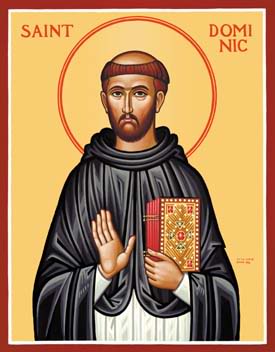
Dominic was born in Castile, in Spain, in 1170. He entered the priesthood, and eventually became prior of the canons of the cathedral chapter (the clergy who formed the staff of the cathedral and conducted the daily worship services) at Osma (42:52 N 3:03 W). The turning point of his life came in 1206, when he was chosen to accompany the bishop on a visit to southern France, to an area held by the Albigenses. These were a heretical sect more or less directly descended from the early Gnostics and Manichees. They were dualists, holding that there are two gods, one the god of goodness, light, truth, and spirit, and the other the god of evil, darkness, error, and matter. The material universe is the creation of the bad god. The good god made the souls of men, and the bad god kidnapped them and imprisoned them in bodies of flesh. On their first night in Albigensian country, they stayed at an inn where the innkeeper was an Albigensian. Dominic engaged him in conversation, they sat up all night talking, and by dawn the man was ready to become an orthodox Christian. From then on, Dominic knew what his calling in life was. Dominic and his bishop undertook to study the Albigensian beliefs and to engage in public debates with their opponents. They seemed to be making some progress, but in 1207 the bishop died, and in the same year the murder by Albigenses of the papal legate moved the pope to declare a crusade against the Albigenses, which lasted about five years.
Dominic continued to preach and to debate where he could, and in 1215 he founded an order of preachers, who were to live in poverty, and devote themselves to studying philosophy and theology and to combatting false doctrine by logical argument rather than by the use of force. He was convinced that a major obstacle to the conversion of heretics was the material wealth of some of the clergy, which made plausible the accusation that they were concerned for their purses and not for the glory of God, and made workers indisposed to hear them. He therefore determined that the brothers of his order should live lives of poverty and simplicity, being no better off materially than those they sought to convert. When he was in Rome, seeking authorization for his order from the Pope, the Pope gave him a tour of the treasures of the Vatican, and remarked complacently (referring to Acts 3:6), "Peter can no longer say, 'Silver and gold have I none.'" Dominic turned and looked straight at the Pope, and said, "No, and neither can he say, 'Rise and walk.'" He got the permission he was seeking, and the order grew and flourished. Officially known as the Order of Preachers (hence the letters O.P. after the name of a member), it was informally known as the Dominicans, or the Blackfriars (from the color of their cloaks). Two of their best-known members are Albertus Magnus (Albert the Great, 1200-1280, see 15 Nov), who was famous for his learning in numerous fields, and his pupil Thomas Aquinas (1225-1274, see 28 Jan), who wrote reconciling Christian theology with the philosophy of Aristotle, which was then being rediscovered in western Europe, and was thought by many to be a threat to Christianity. In later years, the Order forgot its commitment to "logic and persuasion, not force" as the means of bringing men to Christian truth, and many of its members were active in the Inquisition.
Dominic was three times offered a bishopric, and refused, believing that he was called to another work. He died in 1220 in Bologna, Italy (44:30 N 11:20 E), after a preaching mission to Hungary. His emblem in art is a dog with a torch in its mouth, a pun on his name (the Dominicans are sometimes called the "Domini canes", the hounds of the Lord), and a reference to his relying on the power of preaching.
Manipulación y distorsiones

¿Por qué tiene que ir al escenario de los hechos el ministro o jefe
superior?
Ernesto A. Holder
opinion@laestrella.com.pa
opinion@laestrella.com.pa
Sean McBride pudo haber sentido pena
cuando el informe de su comisión fue rechazado en 1980. El documento llamaba,
entre otras cosas, al establecimiento de ‘nuevas tareas sociales para los
medios de comunicación' y también a ‘aminorar (…) las distorsiones que se
producen en el momento de la difusión de la información'.
Independientemente de nuestro
entendimiento sobre las causas actuales de la situación social y, el indudable
poder que sobre ella ejercen los medios no me deja de asombrar —realmente
asombrar— cuando las prácticas para difundir información han evolucionado hacia
otros fines lejos de los objetivos generales de informar. Y muchos sectores de
la población que pensaríamos ejercerían mejor juicio para contrarrestar esta
desviación social (incluyendo el Gobierno nacional), han caído en la trampa
mediática: la lucha por el rating y elevar el puntaje en las encuestas.
Subrayo dos eventos ocurridos en un
espacio de ocho días. Carlos Jaramillo, molesto (por no decirlo en buen
panameño) por las repetidas boletas que le han aplicado por violar las normas
del tránsito, provocó la movilización de todos los estamentos de seguridad del
Estado cuando subió al Puente de Las Américas para suicidarse. No era un
terrorista, ya había protestado antes. Jaramillo, cantante de reggae que se
hace llamar ‘Big Charlie ', se tomó un ‘selfie ' y lo subió a las redes
sociales. Se apersonaron al área el ministro de Seguridad Pública, Alexis
Bethancourt, y José Donderis, director del Sistema Nacional de Protección Civil.
También llegaron agentes del Servicio Nacional Aeronaval, del Cuerpo de
Bomberos de Panamá y de la Policía Nacional.
Días después, en la tarde del martes
25 de julio, se dio un incendio en el complejo comercial Los Pueblos. Además de
los bomberos, todos los estamentos de seguridad acudieron al área nuevamente
para ocuparse de las responsabilidades inherentes. Creo que hay una diferencia
notable entre el fuego y el caso del puente con lo que respecta a la
movilización de tantos recursos para atender y resolver cada uno de estos
asuntos.
Probablemente pocas personas ven
estos evento desde mi perspectiva, pero lo que me llamó la atención por una
parte, fue la cobertura que le dieron los medios televisivos: en vivo y directo
y ahora con toda la tecnología que tienen a su disposición. Y por la otra, en
el proceso de comunicación de las autoridades. Percibo una desviación inusual y
desafortunada.
En eventos que de alguna manera
afectan la seguridad civil, la responsabilidad es la de orientar a la comunidad
que puede ser afectada inmediatamente y por las consecuencias. Lo que percibí
fue la ya conocida lucha por el rating y, peor aún, el interés de algunas de
las autoridades por puntualizar y enaltecer su desempeño. En medio del esfuerzo
por sofocar el incendio, el encargado de los bomberos tenía cifras muy
puntuales de la cantidad de personal atendiendo el fuego, carros especializados,
ambulancias, equipos, etc., además de varias líneas bien exactas sobre ‘lo
rápido que han respondido las Fuerzas de Tarea Conjunta, los estamentos de
seguridad… y otros mensajes puntuales ( talking points ) diseñados por los
supuestos estrategas de comunicación y que en ese momento no venían al caso.
Podemos ser condescendientes y darle
espacio para divulgar mensajes específicos, pero durante el desarrollo de una
actividad peligrosa, la propaganda institucional no me parece. hicieron lo
mismo con el sujeto del Puente de las Américas, resumir los objetivos de la
institución en el marco de una situación difícil. ¿Por qué tiene que ir al
escenario de los hecho el ministro o jefe superior?
No hay manera de evitarlo: si estamos
considerando seriamente llevar adelante las reformas necesarias para ‘arreglar'
los asuntos nacionales en los que la desmesurada corrupción es lo que nos
indigna, debemos echar un vistazo a los medios de comunicación y el papel que
juega en todo el sistema social.
Los famosos estrategas de
comunicación solo funcionan para la propaganda y para desviar la atención. La
única estrategia que cabe para los que nos gobiernan debe ser: decir la verdad,
eso estamos esperando del caso Odebrecht y los otros temas de corrupción que
nos acechan desde las esferas oficiales y los grupos de poder. Si hay que
‘patear la mesa', como dice Pedro Rivera, o revolucionar todo el sistema,
indudablemente tenemos que redefinir los procesos de comunicación y el papel de
los medios de comunicación.
COMUNICADOR SOCIAL.
Suscribirse a:
Entradas (Atom)